Friday, 3 October 2014

Prince Caspian

Let’s begin with the obvious: Andrew Adamson’s 2008 film adaptation of Prince Caspian is a work of literary vandalism of the very highest order. It distorts its source’s moral meaning, it loads it down with an inordinate surplus of violent spectacle, it displays an overt cynicism in its imitation of the Lord of the Rings trilogy, and just for good measure, it adds a teen soap-opera angle that C.S. Lewis would never in a million years have countenanced. And it’s all a joyous, brilliant experience to behold. I walked into this film with my teeth firmly gritted, having hated every minute of Adamson’s film version of The Lion, the Witch, and the Wardrobe three years before, but nonetheless masochistically wanting to keep up with the latest Hollywood fantasy spectacles. Imagine, then, my surprise at finding that the blockbuster success of The Lion, the Witch, and the Wardrobe had evidently emboldened Weta and Disney to let Adamson try some new things second time around, and he in turn used this looser reign to make a very different movie than Lewis purists probably expected.

Prince Caspian begins being remarkable in its very first image, which is a sudden, intense zoom-in onto a woman screaming in the throes of childbirth. This is striking because the female, procreative aspect of Nature is one which Lewis always instinctively resisted. Certainly there was nothing like this in his original book, which glossed over the whole development with the phrase “there came a time when the Queen seemed to be ill and there was a great deal of bustle and pother about her in the castle and doctors came and courtiers whispered.” Anything more than this would have led Lewis places he wasn’t willing to go. The phrase “Mother Nature” is not a mere accident of idiom, but contains the inherent truth that it is woman, with her procreative function, who really embodies Nature and its fecundity and continuity. In the most blunt biological terms, we men are little more than sperm donors, with the potential additional uses of bodyguards and/or errand boys. As Camille Paglia once wrote, the invention of a patriarch creator-God was the male of the species’ “declaration of independence” from this state of irrelevance before Mother Nature. In other words, men had to invent a He who, in turn, had created the She of Mother Nature and all her workings. Paglia viewed this as a useful fiction because it has, over the course of human history, emboldened men to invent and organize a great deal of useful things that are surplus to the basic requirements of Mother Nature. Lewis, however, would have been repelled by this characterization of Christian monotheism as “a useful fiction,” because he genuinely believed in it. Thus, dwelling on the biological workings of Nature, in all its feminine procreative aspect, is verboten in his work. That Prince Caspian the film so blatantly contradicts this in its first sixty seconds gives one an initial sense that all bets are off, and that this film could go in any direction...
And so it proves. After this initial childbirth scene, we see a Telmarene soldier enter a throne room and tell Lord Miraz that he has a son, after which we introduced to our titular hero and his tutor, and a few shots later the film’s first action sequence – a big chase on horseback – has begun. What with all this, we’re almost ten minutes into the film before we cut to 1940s England and meet Susan, Lucy, Peter, and Edmund, and by this point it comes as something of a shock. In Hollywood cinema especially, the first few minutes are always the most crucial in establishing the terms of a film’s world and worldview, and Prince Caspian has here knowingly and deliberated violated the basic narrative structure of Lewis’s first four Narnia books: namely that we begin with the Penvensies/Eustache/Jill in the “real world” of wartime and post-war England, are then magically transported to Narnia for the book’s adventures, and are finally returned to the “real world” of England at the end. Prince Caspian’s refusing of this logic ties in with its emphasizing of female fertility.

Even though Lewis’s Narnia books never actually invoke the “it was all a dream” approach of Carroll’s Alice’s Adventures in Wonderland or the film version of The Wizard of Oz, there is nonetheless a sense of hierarchy of reality at work, whereby Narnia is a sort of figuration of the realm of Faerie – accessible only to prelapsarian children for purposes of socialization, who must of necessity be banished from it as they mature. This theme would eventually be brought to a hideous culmination which I’ll discuss later on, but for now it’s sufficient to say that the unspoken-but-obvious corollary is that “mature” here means sexual maturation – or beginning to exist on the terms of the Mother Nature who Lewis cannot admit of. This gives the game away, insofar as Lewis isn’t wanting to depict Narnia as a literal “other world” in comic-book terms of “another dimension,” or Philip Pullman-style “another string in the multiverse,” or even Tolkien’s planet “Arda,” but as a sort of ur-reality that shows how the world should be, if only it didn’t have this damned fact of female-sexuality-cum-Nature in it. “Since the fairy-story deals with ‘marvels,’” Lewis’s friend and colleague J.R.R. Tolkien once wrote, “it cannot tolerate any frame or machinery suggesting that the whole framework in which they occur is a figment or illusion.” What with all the ideological baggage described above, Lewis’s Narnia stories still clear this requirement, but only just. By literalizing Narnia’s existence in such blunt “other dimension” terms, Prince Caspian the film simply obviates and dismisses all this tortuous logic. It’s another beautiful example of the film’s steak of creative vandalism.

In keeping with this idea of Narnia as a realm of moral socialization, moreover, one of the things I’ve always found most distasteful things about The Lion, the Witch, and the Wardrobe, both book and film, is the way that while Lewis pays lip service to the idea that there’s always room in Heaven for a repentant sinner – what with Edmund being redeemed and forgiven after being inveigled by the White Witch – there’s always seemed to be a deep undercurrent of smugness to the whole business. Lewis loads all of the sinful fallibility onto Edmund’s character, while keeping Peter and Susan’s consciences spotlessly clear, and making Lucy the cherubic angel of the bunch. This one-dimensionality is too much even for a children’s story, or perhaps especially for one. Of course you’re forgiven, the story seems to say, but the rest of us children have never been bad – never done anything we need to be forgiven for, have we? Excuse us while we smirk and snigger superiorly at you behind your back… Prince Caspian the film is brilliant because it seems to sense this same logic, and takes drastic steps to neutralize it. The film moves aggressively to knock Peter off his high horse. Our first sight of him in England has him brawling with some other schoolboys in the tube. After meeting Caspian, the film turns into a fiesta of clashing egos between the two kings. And then, at the climax of the second act, the film offers perhaps its most mind-boggling scene. We see, through a magic mirror/screen, the avatar of Tilda Swinton’s White Witch, just a single touch away from reviving and living again. She begins seducing Peter with promises that he can recapture his former glory. Peter is obviously amenable. She reaches out… He’s almost about to seal the deal with his touch… When suddenly the screen shatters and collapses, taking her out again. We see that Edmund has stabbed it from behind. “Yeah I know, you had it sorted,” he quips, fixing Peter with a very knowing look. It’s one of the most brilliant moments I’ve ever had the pleasure of seeing, in how it fluently reverses Lewis’s moral logic.

The points of outrageousness continue. In Lewis’s books, Father Christmas gives Susan a bow and a quiver of arrows, but also declares that “I do not mean for you to fight in the battle,” and “battles are ugly when women fight,” and we accordingly never see the weapon really used. Not so in this film. After first seeing it in the theatre, it was one of my bigger points of joyous incredulity that “you’d need a huge scorecard to keep track of how many people Susan kills.” Indeed, keep a sharp eye out at the 1:16:08 mark of the film, and you’ll actually see her dispatch one Telmarene soldier at close range by stabbing him in the groin with an arrow! Likewise, Edmund gets to be a great deal more kick-ass as well. In Lewis’s book, the fact that he is the one to fight an initial sword duel with the dwarf Trumpkin – by way of proving that although they seem to be children, they’re still warrior-king material – is tortuously legitimized with “No, let me do it. If will be more of a sucks for him if I win, and less of a let-down for all of us if I fail.” In the film, Peter simply declares “Not me. Him,” and Edmund then duly hands Trumpkin his ass on a platter. We’re left with the suggestion that Edmund is actually the more skillful swordsman, an impression strengthened during the later sequence of the abortive storming of Miraz’s castle. Among other bits of business, we see Edmund almost casually kill three Telmarene soldiers in quick succession, barely breaking stride as he dashes across a castle turret. Even Lucy’s character is made slightly sharper and harsher for the film. In the books, the dirk that Father Christmas gives her is never used. Here, keep an eye out for the 1:29:56 mark, and you’ll see her with it out and genuinely poised to slit Nikabrik’s throat. Moreover, when they finally meet, Aslan says to Lucy that “if you were any braver you would be a lioness” – a deliciously subversive line, in that it abruptly imaginatively cues us to wonder about Aslan’s sex life, something emphatically not gestured towards in Lewis’s books.

All of this is mere prelude, however, to the film’s greatest coup, and most invaluable vandalism of its source material. The most unacceptable part of C.S. Lewis’s book series, for me, comes at the end of the twelfth chapter of The Last Battle, where we learn that Susan “is no longer a friend of Narnia.” She is “interested in nothing nowadays except nylons and lipstick and invitations. She always was a jolly sight too keen on growing up.” In other words, she’s grown from a sweet little girl, tractable to the Christian harness, into an actual grown woman, with all the amoral trappings of sex that Christianity has never been able to control or accept. She’s no longer a “daughter of Eve,” to use Lewis’s terminology, but a daughter of Mother Nature, showing up Christianity’s fictiveness and inadequacy. Lewis’s only answer to this is “banish the bitch,” so as to keep his imaginative Christian playground-utopia intact.

I’ve never been the hugest fan of films such as The Notebook, Mamma Mia, The Vow, or Eat, Pray, Love, or TV shows such Sex and the City, Girls, or Desperate Housewives, but I consider that more a failing in my own education than a reflection on the worth of these things. I find their very existence reassuring, as well as the fact that their fans take them very seriously indeed, because these facts in and of themselves constitute a stinging rebuke to Lewis’s hysterical attempt to deny the reality and legitimacy of adult womanhood. Thus, it was with enormous glee that I saw a great part of Prince Caspian seeming to have been made in exactly this spirit. 
Near the ten minute mark, when we finally cut back to England, the first Pevensie that we see is Susan, and our immediate impression is that actress Anna Popplewell – now pushing twenty in real life – is looking very grown-up indeed, with pillowy, lipstick-covered lips almost evoking Angelina Jolie. And occupying the frame thus, she is standing at a kiosk, reading a magazine – no doubt some gloriously frivolous teen thing which is feeding her love of nylons and invitations – before having to beguilingly and toyingly fob off some gormlessly awkward boy who’s trying to hit on her. Soon enough, she finds herself back in Narnia – evidently still a friend of it after all, in spite of everything – but nonetheless confesses to a certain ambivalence about the fact, having spent the last year of her life getting used to being back in England. In other words, Adamson & Co. have accepted and inverted Lewis’s moralism, the better to deflect The Last Battle’s monstrosity, an astonishing five books in advance! It’s almost a shame The Last Battle will never get made, just so we can see what would ultimately have been done with it when the time came…

In the event, Susan’s new, more grown-up characterization is soon used to generate a romantic subplot with Caspian, played by the swoon-inducingly swarthy Ben Barnes. They don’t conclusively end up together, because, as Susan says after their (very striking) good-bye kiss, “we would never have worked anyway … I’m 1300 years older than you.” To say that all this was not in Lewis’s novel would be an understatement of the century. Any cyclones in the vicinity of Headington Quarry’s Holy Trinity Church can henceforth be explained by the intensity with which Lewis is spinning in his grave. And yet, even beyond its specific application in this case, this is exactly the kind of literary adaptation that I most appreciate – the kind that is unafraid of making big, shameless bowdlerisations to its subject matter simply in the interests of cinema. As well-done as a film like Atonement was, that kind of filmmaking’s abject servility to its source material always exasperates me. How much more fascinating would it have been to simply – in an impishly contrarian spirit of mischief – rewrite Ian McEwan totally? For instance, having Briony be deployed across the channel as a nurse and redeem herself by finding and rescuing Robbie? Or having the library-tryst scene result in Cecilia becoming pregnant, and her daughter then vengefully stalking Briony in later life?
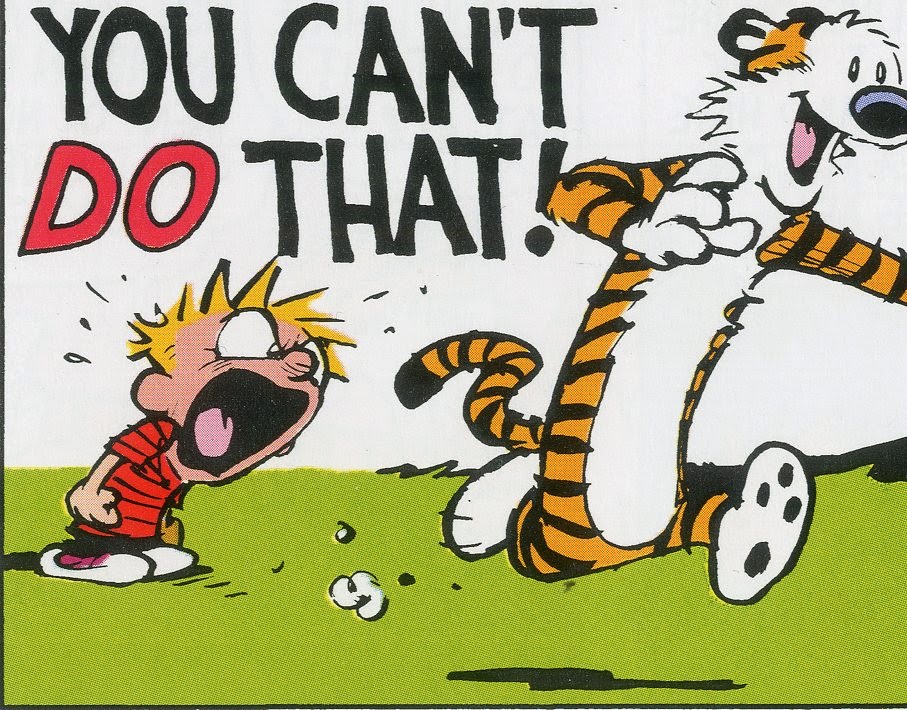
One of my favourite examples of this kind of adaptation – one of the few that approaches what Adamson does with Prince Caspian – is the 1994 version of The Jungle Book, which rewrites Kipling to make Shere Khan into a benign and noble guardian-figure. Listening to the DVD commentary for the film, one hears director Stephen Sommers blithely declaring, with a total lack of self-consciousness, that the tigers they hired to play Shere Khan just looked so majestic that demonizing them as villains just didn’t seem cool, so they rewrote the story accordingly. One can readily image Kipling purists’ reaction to this approximating Calvin’s at left, but I always sympathize more with Hobbes’s look of jubilation at his own chutzpah. It’s my firm belief that, fundamentally, this is how art really advances, rather than though the dignified refraining from “taking liberties.” And as such, I’d rate Prince Caspian a very great piece of film art indeed.


Monday, 31 March 2014

The Land Before Time


Back in January, I had the chance to see The Land Before Time on the big screen, thanks to the Family Favourites weekend screenings that Cineplex Odeon runs. This was a film that I saw for the first time when I was only four or five years old, and which made such a tremendous impression on me at that tender age that I’ve never forgotten it since. The juvenile dino cast of Littlefoot the apatosaurus, Cera the triceratops, and their hangers-on Ducky the saurolophus, Petrie the pterosaur, and Spike the stegosaurus, had become part of my imaginative landscape, and the movie they starred in part of my innermost canon. The obvious caveat to all this, however, is that such childish loyalties are not based on real critical judgment, and when you go back and revisit their source more than twenty years later, you almost always find things very different than you remember. My experience seeing The Land Before Time was no exception.

The first three and a half minutes of the film are pure movie magic – every bit as wondrous as I remembered. We open on a wall of sediment, lit with a deep underwater blue, and for the first forty-seven seconds of the film simply watch a long, sustained take of this background, punctuated by periodic upsurges of bubbles and the occasional small creature passing before the frame. The point of this lengthy, sustained image seems fundamentally atmospheric – to establish in no uncertain terms that this is a film of some depth and grandeur of conception, not a typical “cartoon for children.” James Horner’s nobly swelling music emphasizes this strongly.

When the image finally does shift, it does so with the impression of a camera track to the right, following a small amphibian-like creature through a richly detailed underwater vista, as it chases a small red minnow, and narrowly escapes the jaws of giant mosasaur-like creature. The image dissolves onto the image of a clutch of weeds swaying gently underwater, before a dinosaur’s mouth descends into frame to chomp them away. With this, the frame seems to track past a natural obstacle, momentarily blacking out the screen so as to display the title, to a surging crescendo of Horner’s score. Following this, the frame continues to track right – onto a richly-detailed wide shot of a group of turtles seeming to soar majestically through the water, in front of a vast underwater cliff face. The frame tracks right with the turtles, eventually losing them behind another underwater outcropping, which masks another cut to a brief close-up of the surface of a pond, with small creatures jumping past the water lilies. We continue tracking right, and dissolve into another wide composition where the long necks of a pair apatosaurus are graphically matched with the tree trunks surrounding them, until they lean their heads down into frame to browse the vegetation on another nearby outcropping.

During all of the above, a voice-over narration, read by Pat Hingle, kicks in on the soundtrack.  “Once upon this same Earth,” he intones, “beneath this same sun… Long before you, before the ape and the elephant as well… Before the wolf, the bison, and the whale, in the time of the dinosaurs.” His deep, curmudgeonly/grandfatherly voice really complement the images here to – just like the opening shot against the underwater wall – suggest that this is going to be a film of much greater aesthetic ambition than most “animated kiddie flicks.”

As Pat Hingle finishes the opening phrases of his VO, the camera continues to track behind the latest obstacle, which masks another cut – this time out into a vast open landscape shot. And it is here, two minutes and forty seconds in, that the film begins to show its true majesty. Throughout the following moments, we see a herd of triceratops migrating off into the distance, down from a hilltop and across a plain towards a mountain range that frames the setting sun; we see a herd of saurolophus migrating across a barren volcanic landscape, with flaming volcanoes in the distant background and clouds of noxious orange-yellow fumes blowing through the foreground; and we see apatosaurs migrating past a lake beneath a full moon, overflown by a flock of pterosaurs. Ultimately, we cut back to the saurolophus herd, which has encamped by a stream in order to nest their eggs.

And it’s here, exactly 3:32 in, that the film goes slack and never really recovers. Because as soon as the eggs do start to hatch, they do so in a cartoony “stretch and squash” style – the ovals seem to strain from inside, and elongate exaggeratedly – which becomes the modus operandi for much of the rest of the film, with spastic and energetic cartoon action taking the place of the sense of real weight and solidity we’ve seen up to now. Everything before this has been done in a fluently hyperrealist style which fully demonstrated the principle that before CGI, animation was the most promising way to depict things that couldn’t actually be photographed or shown convincingly in live-action. Realistic drawings could offer a vivid simulacrum of the real, as with Winsor McCay’s The Sinking of the Lusitania in 1918. Depressingly few films ever did actually use cel animation along those lines, but for its first few minutes at least, The Land Before Time reaffirmed the principle. It’s not that there isn’t plenty of great hyperrealist footage in the rest of the film – there certainly is – but it has to exist in an awkward aesthetic synthesis with cartoonish animation that embodies a diametrically opposed use of the technique. The hybrid nature of the bulk of the film badly undermines the visual majesty that the first few minutes tantalized us with.

All this, however, is simply formal criticism of animation style. If the film’s awkward hybrid of hyperrealist and cartoon animation had been its only problem, I might still be calling it a masterpiece. Alas, the film’s really fatal problem is its script. Apparently, Lucas and Spielberg were interested in making The Land Before Time wholly dialogue-free, and just letting it play out with music and graphic logic, like the “Rite of Spring” dinosaur sequence in Fantasia. When the obvious fact sunk in that this would be commercial suicide for a mainstream animated film, Lucas and Spielberg grudgingly commissioned a script. And it’s perhaps here that the film’s problems began in earnest. Because they’d never wanted to have to have a script in the first place, the relative quality of it seems not to have mattered to them. It’s as though writer Stu Krieger was simply assigned to generate a completely generic iteration of all the usual bromides and formulas – the routine “words of wisdom” from a “wise elder” character early on, which the protagonist will spend the rest of the film trying to live up to;  the “character friction” moments which precede the inevitable rapprochement and “character bonding” moments; the wholly contrived “setbacks and adversity” which precede the inevitable happy ending; and, of course, the lame comic relief which must run parallel to it all. When written with sufficient investment and purpose, the formula aspect of all this can be completely forgotten, and the story seem fresh and vital even if it isn’t remotely. This investment and purpose, however, is totally lacking in The Land Before Time. Virtually all the film’s best moments are those which are free of dialogue, and Lucas and Spielberg can to some degree approach their original ambition and channel the “Rite of Spring” sequence in Fantasia.

Again, had the script been merely generic – and avoided committing any unforgivable gaffes – the film might still have worked at least reasonably well. Alas, however, this was not the case. The one truly irredeemable idiocy of The Land Before Time’s script is what might be called “the Sharptooth factor.” Simply put, the film’s treatment of its T-Rex is idiotic beyond words, and Lucas and Spielberg ought to have known better. The film demonizes the T-Rex, which it calls a “Sharptooth,” as a cruel, slavering monster, from which we are meant to recoil with fear and hatred. How Lucas and Spielberg – the two Hollywood directors most known for their acute insight into the 6-year old mind – could have been so stupid simply boggles the mind. Every child in the world is of course going to view the T-Rex as the real hero-star of the film, and if not actively root for it to eat Littlefoot and his friends, then at the very least not be onboard with wholesale demonizing of it for trying to do so. Furthermore, it’s the word “trying” that takes the film to a whole new level of idiocy. Because of course the Sharptooth can’t actually succeed in killing and eating Littlefoot or any of his friends, and so ends up doubly insulted by being characterized as terrible on the one hand, and yet impotent on the other. This is the very scummiest, most infantile, dynamic of genre filmmaking, whereby a film characterizes its villain in broad, crude terms as totally monstrous and dangerous; but in a childish, temper-tantrum-style insistence that the heroes must always be invincible and immortal and never get so much as a hair out of place, the film can’t ultimately give the villain anything concrete to do to justify their dangerous-monstrosity characterization. The ultimate implication is, simply, that he’s bad because he looks/acts different from the hero, and must therefore be destroyed. In animated films particularly, you can generally judge a film’s worth by how closely it adheres to this logic. The Lion King stands as such a masterpiece because it had the narrative courage to let us fully savour Scar’s killing of Mufasa, giving real weight to his subsequent actions. Last year’s Epic, at the other extreme, was particularly disgusting in its treatment of the Christophe Waltz-voiced villain “Mandrake.” My first thoughts on leaving the theatre after seeing Epic were about the sheer breathtaking effrontery of children’s films which present themselves as morality tales, when their ultimate moral basically seems to be “never play fair.”

The Land Before Time’s treatment of the Sharptooth stands as perhaps an all-time worst for this sort of thing. Most contemptible of all is the way that it censors itself in the one scene that might have balanced the scale a bit: the sequence of Littlefoot’s mother’s death, in a battle with the Sharptooth on a crumbling mountain ridge. The logic of the scene obviously seems to be that the Sharptooth kills Littlefoot’s mother, but in post-production, Lucas and Spielberg decided that this might be too scary/traumatic for children, and the scene was re-edited to give the impression that Littlefoot’s mother fights off the Sharptooth, and simply dies from the fall after the ridge collapses beneath her. The result is that throughout the battle sequence, Sharptooth never seems to get in a single bite or claw, while Littlefoot’s mom is constantly slamming him down with her tail. The scene is beyond infuriating to watch, and this was not an isolated incident. Apparently 19 scenes – a full 11 minutes of footage – almost all dealing with the Sharptooth, were shortened or removed from the film because they were deemed too traumatic for young children. This is American pop culture at its very worst – where everyone is more concerned with the cloyingly therapeutic aspect of representations than their actual quality. For my money, the damage done to children by showing them invidious shit is probably far worse, in the long term, than that done by showing them scary pictures.

So juvenile is the film’s sensibility that even censoring the sequence leading up to Littlefoot’s mother’s death wasn’t enough. They had to cap this whole part of the film by adding an idiotic dialogue-dump whereby a tearful Littlefoot runs into a wise old ankylosaur named “Rooter,” who imparts generic “wise counsel” about how the circle of life has begun, and he’ll always miss his mother, but she remains a part of him, etc. Pat Hingle pulls double-duty here, giving the same patriarchal gravitas that he does to the narration, but the effect is totally opposite. Lucas and Spielberg, who usually know their audience so well, have managed to completely miss the mark here, leaving viewers devoutly wishing that the Sharptooth would resurge and bite the stupid ankylosaur’s head off.

Less idiotic than the film’s treatment of Sharptooth, but still cringe-inducing, is its treatment of the little girl triceratops, Cera. Like so much that came out of Hollywood in the 80s, The Land Before Time lives in a world where a vacuous, blond-haired, blue-eyed boy is paradigmatic of humanity, and anyone or anything not conforming to this type is by definition strange and “Other.” One remembers that just the year before this, audiences had had inflicted upon them not only Corey Haim in The Lost Boys, but also Joshua Rudoy in Harry and the Hendersons. Littlefoot is, if not quite as bad, alas very much in the same tradition. Accordingly, Cera is routinely characterized as being prideful, arrogant, bossy, or outright mean. And just like Sharptooth, Cera isn’t even granted the positives to go with these negatives – the film makes sure to emphasize that she’s always wrong, deluded, and emptily boasting, and that when danger actually appears she’ll simply squeal and run. Even the film’s framing device gets in on the action, with the narration explicitly kicking in to diss her at one point. Early in the film, when Hingle’s deep, gravelly voice talked in generalities about “the mighty beasts who ruled the earth” and “a journey towards life,” the patriarchal gravitas worked dramatically. When, on the other hand, he intones that “Cera was still too proud to admit that she’d gone the wrong way,” it’s like having excrement shoved right up under your nose.

Despite all of the above, however, the film is not without a few redeeming points. As mentioned earlier, the brilliant hyperrealist animation which defined the first few minutes never really goes away, it just has to co-exist with the more cartoony animation. But the really moving, evocative hyperrealist shots – like one which slowly tilts upwards to follow Littlefoot’s mother walking off towards the mountainous horizon, through a forest of bare dead trees – stick in your mind much more than the crude cartoonish ones – like the protracted bit of business where a half-dozen or so pterosaur chicks fight over a berry. And speaking of Littlefoot’s mother, for all that the preceding Sharptooth scene befouled its premise, and the subsequent Rooter scene ruins its payoff, the scene of Littlefoot’s mother’s death is indeed every bit as soulfully dramatic as it was intended. It was perhaps karma that just five months before The Land Before Time’s November release, Disney re-released Bambi, allowing the audience to fully appreciate this film’s audacity in actually, heart-wrenchingly, showing what Disney had simply tiptoed around with suggestion.

And at its very end, the film’s penultimate redeeming feature is its end credits theme – Diana Ross’s performance of “If We Hold on Together.” Many animated films, even great ones like DreamWorks’s How to Train Your Dragon, simply cut to some fairly generic pop music for the end credits, and rely on the general energy and vibrancy to carry audiences out of the film. Ross’s “If We Hold on Together,” does far more than that. Again, I wasn’t more than five years old when I first saw the film, and the song moved me so deeply that, for twenty-three years afterwards – even as so much else of the film faded – I never forgot it or the end credits it accompanied. The song carries a tone of “bent and broken, but unbowed,” whereby the heroes have endured great misfortune, but still persevere because of their solidarity with each other. It’s reminiscent of the conclusion of The Fellowship of the Ring, where Aragorn declares that the fellowship will not have failed, so long as “we hold true to each other.” The difference, of course, is that at that conclusion, Boromir had just been killed, Merry and Pippin just been carried off to some gruesome orc-ish fate, and an increasingly tormented Frodo had wandered off on his own, so there was real weight and pathos behind Aragorn’s assertion. Yet again, The Land Before Time just has no comparable sharpness, even as a children’s film. To really be worthy of Ross’s song, it would have to have ended with Sharptooth having eaten one of the dino kiddies, and the Great Valley still out of reach, so that all they have to sustain themselves is each other. A conclusion on this note would have matched the faintly mournful, elegiac tone of the song far better than the saccharine “happy ending” that does close the film. It’s yet another element that seems either to belong in a better film, or indicate just how much better this one might have been if not for Lucas and Spielberg’s cravenness.

Sunday, 22 December 2013

Desolation of Smaug: The Aliens vs. Predator of Cinematic Tolkien

Now that Peter Jackson’s The Hobbit: The Desolation of Smaug has been out for some two weeks, there seems to be a general consensus that it’s not only a lesser film than last year’s An Unexpected Journey, but easily the weakest of Jackson’s Middle-Earth films to date. The reasons for this vary from person to person – general bloat, extra-Tolkien-ian invention, video-game-aesthetics, action-movie clichés, overt servility as an LOTR prequel, over-reliance on CGI, etc., etc. In what follows, however, I offer my own, hopefully somewhat unique, critique of it…

One of the greatest contributory factors to the Lord of the Rings trilogy’s magic was that it took place in a world wholly other and apart from our own. Tolkien always maintained that creating Middle-Earth was a purely formal exercise for him, with no real-world implications whatsoever, but the key was that he took the formal exercise entirely seriously as such. His academic specializations in Old Norse and Anglo-Saxon history, language, and folklore provided him with the raw material to create a world so detailed – so rich in culture and tradition – as to feel real in a way that (seemingly) no previous fairy stories ever had. Paradoxically, Middle-Earth became more fantastical for seeming less so. Being given enough texture of detail to really believe that Theoden’s people would not have felt out of place in the England that Harold II ruled on the eve of the Norman invasion meant that the wizards and balrogs seemed less fantastically imaginary than they would have otherwise. Fantastical beings that seem really to exist in their own densely historicized world, rather than simply being appreciable as the Freudian projections of the author – presented sui generis and at face value – was and remains an amazing literary achievement. More than enough, for plenty of readers, to offset Tolkien’s insufferably retrograde views on most real-world matters.

It was exactly this dynamic that Jackson captured so successfully in the films. One got the sense that the locations we saw were deeply imbued with a history which we could understand and appreciate, but that is nonetheless nothing to do with our world. And it is this dynamic that Jackson loses badly in The Desolation of Smaug. In retrospect, the opening sequence gives a foretaste, although the first-time viewer won’t know it at the time. We’re back in Bree – “On the Borders of the Shire,” a subtitle helpfully reminds us – watching Thorin tramp through the streets, and arrive at the Prancing Pony.  The obvious, calculated re-tread of The Fellowship of the Ring, right down to Jackson making the same cameo as a carrot-munching hobo, doesn’t bother me. What does, with retrospect, is the way the sequence is handled. In Fellowship, the scene there was heavily stylized to underscore Frodo’s discomfiture at being away from the Shire for the first time, with the Ring already working on him, and Gandalf unaccountably not there. We got a lot of lurid, slow-motion close-ups of scruffy, bearded, hard-drinking men, all potentially gazing threateningly at Frodo. This scene would climax in one of the most vivid images of the trilogy: his slip backwards, into an overhead shot of him grabbing for the Ring in mid-air… only for it to slip onto his finger, whereby the bar of the Prancing Pony is replaced by the giant eye of Sauron declaring “I see you.” The Prancing Pony might have resembled an innocuous medieval pub in theory, but in practice the resemblance was negligible.

In Desolation of Smaug, however, Jackson goes the complete opposite route. Here, we see Gandalf meet Thorin with a mug of ale and a basic hunk of bread in front of him. Gandalf catches the attention of a passing hale and hearty waitress and says “I’ll have the same.” This is soon brought to him in the course of his tête-à-tête with Thorin. There’s really not much more to it than that. The scene is handled with ordinary film grammar – no surreal subjectivity of any kind, and certainly no ringwraiths bursting in later on. The Prancing Pony has now become, in practice, the innocuous town pub it only was in theory before.
Again, all this is not in itself a problem. The problem is that it foreshadows the course of the film from the second act on: the film’s vision of Laketown deviates too far from Middle-Earth’s fantastical side, and becomes virtually indistinguishable from a setting in our world a few centuries past. Laketown, as we see it in Desolation of Smaug, is essentially a harbour town in Georgian England, and a few minutes of screen time spent there is sufficient to totally remove the spectator from the epic fantasy realm of Middle-Earth. Far from attempting to downplay this, Jackson seems almost to have perversely embraced it. When Bard first arrives at the town gates on the Long Lake, he has to reckon with “Alfrid,” the town Master’s deputy, who is characterized as exactly the sort of hatefully officious, micro-megalomaniac, middle-management type one is occasionally unlucky enough to meet in the real world. His only concern is with stamping Bard’s paperwork, and then sneeringly informing him that he’s only registered to be carrying barrels, not fish, and thus that he’ll have to dump the latter overboard, the town’s food shortages notwithstanding. This seems so wearyingly relatable to Earth in the here and now, that the elves and orcs we saw just a few moments ago already seem less real.

This only continues when we meet the Master himself, as played by Stephen Fry. It’s seeing the interior of his house – with its canopy bed, its dark oak panelling, its framed portrait of him above the mantle – that really solidifies the film’s Georgian England connotations. Along with this, there’s Alfrid’s warning him that “the people are growing restless; there’s even talk of an election,” to which the Master can only say piffle and demand a brandy. It’s exactly the same tone one’s read or seen a thousand times before in British literature and television adaptations: the degenerated old-school squire, landowner, or aristocrat refusing to accept that his powers aren’t innate in the natural order of things, and that majority rule is anything other than absurd.
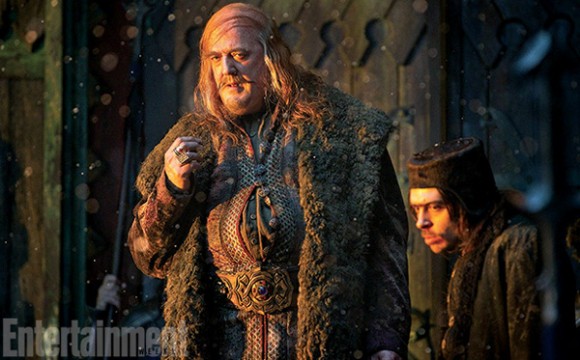
Beyond this, Laketown itself is far less fantastical than any other Middle-Earth environs we’ve ever seen. The piers, impromptu canals and walk-ways, the various boats, the familiarly-shaped houses – all of it as convincingly wet, icy, used, and lived-in as any LORT set – serve to remove us from a realistic fantasy world, and simply plop us back into the real world. Even if we’ve never inhabited a place quite like this ourselves, it just seems to cross a threshold of relatability such that we’d be unsurprised to find out that there really is or was exactly such a place. The fact that so many of the dwarves – Richard Armitage as Thorin and Aidan Turner as Kili especially, but Dean O’Gorman as Fili and James Nesbitt as Bofur not far behind – are cast to look more or less human, rather than like John Rhys-Davies’s Gimli in LOTR, only completes the illusion. For a relatively lengthy stretch in The Desolation of Smaug, we’ve effectively left Middle-Earth, and the looming War of the Ring, for England on the verge of the Peterloo Massacre.

And it’s here that my title comes into play. Because The Desolation of Smaug of course does not stay on this odd footing forever. Soon enough, orcs come upon Laketown, with Legolas and Tauriel behind them. And the odd effect of this is much the same as that achieved by Colin and Greg Strause’s much-reviled 2007 film Aliens vs. Predator: Requiem – the film in which the xenomorph “aliens,” so universally famous from futuristic scenarios directed by Ridley Scott and James Cameron, come to terrorize a small Washington State town in the present day. Attacking the kitchen staff at the local pizzeria, shredding teenagers in the high school swimming pool, dashing between steel girders at a construction site to pick off unwary construction workers – one is basically seeing one of filmdom’s most charismatic creatures brought into our own recognizable here and now, just to flatter our sense of our own importance. It’s a lowering of them, to be sure, but also a raising of ourselves, and thus a cheap thrill in its own way. As I’ve said, Requiem was almost universally excoriated by critics for this narrative strategy, but there was a method to its madness, and one that I sort of appreciated. It is that same method that Jackson is invoking with Desolation of Smaug.

After enough time to acclimatize to Laketown as a location more relatable to our world’s recent past than Middle-Earth as we know it, it becomes doubly shocking to see orcs start bursting in the windows nonetheless. The terrified shrieks that Bard’s children give off are less the hypothetical shrieks of the imaginary children of Rohan, and more those, by proxy, of real children in the audience. It’s one thing to see a farmstead appropriate to the Dark Ages be attacked and burned by vaguely-defined wild men of the mountains while two appropriately smudged and ragged children have to flee on horseback to Edoras and raise the alarm. It’s quite another to see crudely over-defined savage creatures burst in the window of a family home, to elicit shrieks from implausibly well-scrubbed, shampooed and conditioned children. It’s as though Jackson is already turning his Middle-Earth franchise into its own theme park, within the very confines of the filmic narrative.
And herein lies the final twist, of course. Because no sooner have the aforementioned orcs burst in and elicited said shrieks, then Legolas bursts in after them, in all his Orlando Bloom dreaminess, and slaughters all of them with nary a scratch to himself or the little kiddies. Bard’s house will likely look just familiar enough to suburban children in Auckland, Los Angeles, London, Toronto, etc. to give a scary frisson to the orcs bursting in at them, but this will then be compensated for by the sheer coolness of Legolas bursting in after them and kicking ass. It’s essentially just a much more violent version of getting to shake hands with Mickey Mouse at Disneyland, or seeing C-3PO and R2-D2 appear on The Muppet Show, or seeing the aliens go into teen-slasher mode. On the one hand, kids accept the fact that these beloved figures of popular culture exist in their own fantasy never-world – that’s an inextricable part of what makes them so beloved – but on the other hand, there’s an ineradicable part of us that wishes they could descend into a more intimately recognizable realm closer to our own, so that we can feel that much closer to them. At the most cutesy-twee level, every child knows it would be a crime beyond reckoning to wrench Pooh out of Hundred-Acre Wood, but on the other hand, what child in the world wouldn’t also dream of getting to establish Pooh in their own backyard? And at a more familiar, perverse level, what kid wouldn’t want to see their hometown, rather than Tokyo, levelled by Godzilla on his next rampage? 

Such is the logic I saw Jackson using in the Laketown segment of Desolation of Smaug. Put like this, it may sound very interesting, but in practice watching it, I found it very frustrating. Legolas’s relative invincibility was never too distracting in the LOTR trilogy, because he was only one part of a much larger cast, and his never missing with his bow, and never getting a hair out place under any circumstances, was basically just his character note. When he’s absolute and total centre stage, however, as in these parts of Desolation, his bleach-blonde pretty-boy insouciant-invincible characterization becomes insufferable very fast. One is frankly cheering for the big orc captain to get the better of him, and then seething with frustration knowing there’s no way that’s going to happen. This brings me back to the spectatorship dynamic I discussed regarding Sucker Punch once. I find it applies to Desolation more than any film I can remember seeing recently, and for exactly the same reasons as Sucker Punch. Think, they both involve dragons…

Thursday, 10 October 2013

Balto: A Great Film Trapped Inside a Mediocre Movie


In a previous post, I mentioned that I found an immense amount to enjoy in Rod Lurie’s The Contender, but with the rather glaring exception that I found the titular protagonist insufferable. Its strong supporting cast, its excellent cinematography, its genuine fascination with the workings of politics, however – all these things in combination allowed me to look past Joan Allen’s sanctimonious heroine. The 1995 animated film Balto represents, for me, the polar opposite extreme. Here is a film where the overall work is badly riddled with problems, almost to the point of not being worth watching, but is ultimately redeemed by having an endlessly engaging and likeable hero.

Simply put, I like Balto enormously as a character. This is actually rather rare for me. As I mentioned in another previous post, I often find the heroic leads in Hollywood movies unrelatable at best, or outright hateful at worst. For one to actually win me over completely is unusual, but even a cursory look at its qualities will reveal that Balto is a very unusual film. It was the final feature  produced by Amblimation – the spin-off company of Steven Spielberg’s Amblin Entertainment, devoted purely to animation. The inordinate influence of the Spielberg imprimatur on 1980s pop culture has always been well-understood, but people tend to remember things like Poltergeist and The Goonies more readily than An American Tail and The Land Before Time. The latter films, however, may be more radically important, since Hollywood animation had for so long been the near-monopoly of Walt Disney Studios. By lending his immense name recognition to animated films that would break this mould, Spielberg helped expand the conceptual boundaries of what could be done with animation in the mainstream. Balto would be the penultimate project of this expansion, and its problems are those of a production which is testing the boundaries whereby an “animated film” becomes simply a film that is realized via animation.

Balto’s creators seem to have wanted to make an animated film that would be a completely de-Disney-fied, straightforward epic drama, but nonetheless panicked that audiences used to Disney films weren’t ready for such an endeavour. Unwilling to give up their serious ambitions, however, they hedged their bets by salting in an inordinate amount of cartoonish humour, of a buffoonish kind even lower than Disney’s usual tenor, in the hopes that they would leaven each other, and the final film would gel. In the event, however, this calculation failed miserably, and we are left with a movie that is partly a rare masterpiece, and partly a disposable Saturday morning cartoon. Probably the chief reason I ultimately emphasize the former, however, is that the characterization of its hero resides in the first column.

Beyond being excellently animated, about which more later, Balto is very compelling as a character. A wolf-husky hybrid, he lives on the outskirts of Nome in the hull of a wrecked ship – outside of society but still looking in. He sees the achievement and camaraderie of the sled dog teams, and the affection that the humans have for their dogs – especially the young girl Rosy, whose fiery-red husky “Jenna” he’s secretly in love with – and longs to be part of it all. His lupine blood, however, means that this society spurns him, even though his inordinate strength and speed means there’s so much he could do for it. One brilliant scene has him slinking off dejectedly to his ship, only to see a pack of wolves passing on a nearby ridge. They pause expectantly, evidently recognizing him as one of their own and inviting him to join them, but he can’t bring himself to abandon human society totally – even his own pitiful and peripheral place in it. The film’s narrative soon offers a way to cut this Gordian knot, however, when an outbreak of diphtheria means that an isolated Nome stands in need of a saviour. Balto may never have been able to be accepted, but he now has the chance to vault beyond acceptance and become revered. The severity of the threat to Nome is emphasized by a number of shots of impassable pack ice and blizzard conditions, more hyperrealistic than almost anything Disney has ever done, and a haunting shot of the local carpenter building a number of child-sized coffins. 

All this is obviously deep stuff indeed to throw at preteens, and so the film engages in what amounts to a campaign of wilful vandalism against itself. In addition to a comic sidekick – a goose named “Boris” with a heavy Russian accent – Balto is flanked by a pair of polar bears named Muk and Luk who are also ostracized from their kind because they can’t swim. Jenna, meanwhile, is given two friends named “Dixie” and “Sylvie,” who speak like Manhattan Jewish socialites. And the film’s ridiculously exaggerated villain “Steele” – the current head sled dog – is given a trio of flunkies named “Nikki,” “Kaltag,” and “Star,” who have a running shtick whereby Star effusively babbles until Kaltag shuts him up by punching him. It’s the sort of gag that works well enough in TV cartoons, but woefully undermines Balto’s best cinematic qualities.

And there are plenty of those. The film’s single greatest moment comes at the 57-minute mark, after Balto's initial attempts to lead the dogsled team seem to have failed, and he and the diptheria antitoxin have been swept off a cliff. The first image we see is of Balto shoving his head up out of the snowdrift he’s been buried in. Following that, there’s an amazing four-second shot of him pulling himself back up above ground, incredibly strongly backlit in a heroic low-angle framing. After this, however, he lies down in apparent defeat, muttering “Rosy” as he lays his paw across his snout. A cut out to a medium-long shot here reveals the film’s technically hybrid nature, inasmuch as Balto himself is still drawn with pencil and ink, but the blizzard that’s raging unforgivingly around him has obviously had a lot of help from CGI. Faced with the contrast, I still feel nostalgic for the analogue side of the equation, in spite of all the amazing things digital animation can do.

Cutting back into a close-up of Balto’s face, we hear a magical-sounding sparkling noise from offscreen. As he looks up for its source, the camera pulls back and reveals the paws of a great, mystical white wolf standing frame left, which Balto acknowledges with a look of plaintive uncertainty. It’s a great animated-acting moment from our hero, which is followed by a reverse-angle cut to a full-on majestic push-in/tilt-up shot, causing the white wolf to tower over the frame – and thus Balto, and thus us the spectators – just as he flings back his head and lets out a big, dramatic howl. Cutting back to reverse angle, we find ourselves looking over the white wolf’s shoulder, and down at Balto, who now has another brilliant acting moment, turning his head aside totally cowed and ashamed. So subtly nuanced is the animation here that, cutting in to a close-up of Balto turning away, we can really sense that this isn’t from fear so much as his own life-long inability to so totally embody his own lupine identity, the way this noble creature does. It’s an utterly Biblical “pained look away”/“I am not worthy” moment – the sort that’s de rigeur for all epic heroes.

Another reverse angle cut shows Balto’s face now facing the frame, the white wolf now behind him. Thus, we see the wolf turn away in disappointment and seem to leave, but at that very moment, Balto’s eyes suddenly focus… And a cut to his point-of-view reveals that the medicine has landed, intact, right behind him! We then cut back to a new framing of his dismayed face looking upward, at what looks like an impossibly high cliff face. At this point, Boris’s voice cuts in on the soundtrack, repeating his previous admonition that “a dog cannot make this journey alone, but maybe a wolf can.” If nothing else, this moment demonstrates that, as superfluous as the Muk/Luk/Dixie/Sylvie/Nikki/Kaltag/Star constellation of characters may be, Boris’s presence in the film is justified, inasmuch as every epic story needs its clown-sage character to offset the hero. And with the following cut, Balto does indeed move into unequivocally heroic mode, as a close-up shows his features smoothly shift from plaintive/sorrowful to iconically steely and determined (the screenshot above left doesn’t do it justice), sharply turning and facing into the blizzard defiantly, rather than defeatedly like just a moment ago.

With the next cut, we see that the white wolf has seemingly gone, but has left a trail of wolfy pawprints behind. In the familiar image of the MCU composition from earlier, we see Balto extend one of his own paws and place it in the print… and it fits perfectly. Balto has found his own kind in the great and noble creature we’ve just seen, and with this epiphany, he raises up his own head and lets out a huge, dramatic howl of his own. At this point, the “camera movement” really goes all-out, circling him 180° so that in an unbroken take, we can see the white wolf reappear and join him in his howl. This done, we then cut to a long shot of the two of them in profile, heroically twinned. All throughout this scene, meanwhile, James Horner’s epically powerful score has forbidden the viewer a single second’s possibility of dismissing things as “just a cartoon.”

I first saw this scene in the theatre in the summer of 1995, when I was nine years old, and it made such a vivid and indelible impression on me that from just that one showing that I never forgot it over the following sixteen years. Finally revisiting the film for the first time in spring of 2011, at the age of twenty-five, I was humbled to find it still worked as potently as before. Gratifyingly, someone’s uploaded the scene in its entirety on YouTube here, and the fact that it’s been viewed over 200,000 times there gives some indication of how potent a moment it is.

For whatever strange reason, this bit always puts me in mind of a plot point from The Lives of Others, where we see Dreyman coming face-to-face with the fake nationalist-propaganda play that Weisler has written to cover for him. The excerpt we hear consists of boilerplate heroism such as “Lenin is very tired, but he resolves to continue on with his revolutionary plans…” We’re supposed to condescendingly roll our eyes at the crude socialist realism earnestness of it, and its tone-deafness to any irony or nuance. And yet this great moment from Balto shows that there are always moments in dramatic art where this sort of full-bore, un-self-conscious heroism not only works, but is the only possible choice. Substitute “Balto” for “Lenin,” and “rescue effort” for “revolutionary plans,” and you pretty much have the dramaturgy of this scene. And anybody who could remain wholly unaffected by it, or dismiss it as unsophisticated, is likely the sort of glib poseur and/or hateful philistine I would never wish to have to interact with. It’s probably not a coincidence, incidentally, that The Lives of Others was one of William F. Buckley’s all-time favourite films…

The rest of the film continues in the vein of this scene, with Balto dragging the medicine up to the top of the cliff, being definitively invested with the honour and authority of head dog, and successfully leading the team across the many treacherous obstacles presented by the Alaskan wilderness. Alas, it’s not long before the film’s misconceived cartoon elements begin to work against it again. A sequence where the team has to escape a raging avalanche of snow is intense and gripping, but is undercut by the avalanche’s having been started by Star’s sneezing. Likewise, the cutaways to Steele holding court back in town, spinning his own egomaniacal, false version of events does the film few favours.

My chief take-away from Balto today basically boils down to “a great film trapped inside a mediocre movie.” The profusion of cartoonish supporting characters detracts from what works perfectly well as a straightforward epic drama, and a live-action bookend device seems to somehow trivialize even that. It’s a testament to how well the film’s better elements work, though, that in spite of its commercial failure in theatres, it would go on to become an acknowledged classic on home video. The final vindication of it in this regard would come in the early 2000s, when Universal would release not one but two direct-to-video sequels.  These films – Balto II: Wolf Quest and Balto III: Wings of Change – would mercifully dispense with the live-action bookending, and reign in the comic-supporting-character quotient dramatically. Their chief raison d’etre lay simply in giving Balto more to do as a character, whether it be trying to be a good father to his and Jenna’s six pups, encountering a new wolf pack with which he may have a history, coming out of head-dog retirement to lead a mail run, or being a hero again in rescuing a crashed pilot. It’s a gratifying example of a studio recognizing they’re onto a good thing, and going further with it.

Monday, 16 September 2013

Abendland


Nikolaus Geyrhalter’s 2011 documentary Abendland first came to my attention when a friend and colleague chanced to see it, and was so struck with it as to configure her upcoming course to emphasize it. This is always an interesting scenario for expanding your own interests: seeing something surge to canonical status with someone you like and respect, and thus finding yourself challenged to find a comparably deep reaction to it in yourself. What follows is my attempt in this direction…

Abendland consists of some twenty short looks into various scenes of everyday life in the northern countries of Western Europe, unified by the fact that they all take place at night – what used to be called “after hours.” However, beyond seeing a lot of janitor staff at work, the film’s key revelation is how many jobs – such as mail processing, factory work, and political bickering – now go on seemingly 24 hours a day in modern Europe.

All of the short segments are filmed in a chilly, detached style of long takes and distances, with framings that disallow much empathy or identification human with the human subjects. In this, it immediately recalled to my mind two other films made in a similarly reserved German spirit: Geyrhalter’s previous documentary Our Daily Bread (2005), and Michael Haneke’s Code Unknown (2000). The former film is equally poker-faced in style, and the latter speaks to some of the same moral anxieties of Europe today.

The film’s overriding theme is that modern Europe – at least in the more northerly countries such as Germany, the United Kingdom, Holland, Switzerland, the Czech Republic, etc. – has become one big surveillance state, sustained mostly on the back of immigrants. For all non-immigrants, this amounts, essentially, to a blandly benign dystopia where there’s cradle-to-grave health care and plenty of opportunities to carouse and debauch, but nothing much more spiritually fulfilling than that. And here my problems with the film begin. It’s an inarguable fact that the northern European social context we are seeing does provide its citizens with more of a social safety net than North America. For all that neo-liberal reformism has been chipping away at it all for a long time, these economies are still a lot more tolerant of subsidies, welfare spending, make-work programs, and other forms of government intervention which the United States has never and will never see, and which in Canada seem totally in retreat before a Conservative government which wishes to turn it into the 51st American state. In a certain sense then, Geyrhalter is expressing the frustration that comes from chafing against the bars of what is, undeniably, a fairly civilized and humane prison. He can hardly claim that the societies at issue here are like the US in abandoning their to citizens to the naked caprices of the market, with no provision for unemployment assistance or decent healthcare.

A film like this, then, must make these virtues into faults, drawing on that old bogeyman of the “nanny state” that tries to oversee every aspect of your life from cradle to grave. The latter, incidentally, is brought home to one directly in a segment which takes place in a crematorium, with the staff going about their duties in a typically detached and mechanical way. We see a whole room full of generically identical coffins, out of which one or two are rolled, to be taken to a thoroughly non-descript incinerator, after which the ashes are decanted – by a machine that looks like it belongs in a bottling plant – into a thoroughly unremarkable metal container, and placed on a shelf alongside dozens of others like it. Again, this is a behind-the-scenes look at something that we all know about in the abstract, but very few of us have ever actually seen in operation. It can hardly fail to arouse in the spectator a feeling “at the end of it all, that’s all the distinction I have to expect?”

It’s probably due to this sort of thing that the various depictions of health care in action don’t signify as positively as they deserve. We see, at various points in the film, a hospital room given over to the isolated care of an infant with severe birth defects, a team of paramedics going through their paces with speed and efficiency, and an orderly at a senior’s hospital looking in on his patients during the night. In addition, we see some operators for a hotline for people experiencing acute emotional stress or trauma. Objectively, all this should be much more uplifting than it is, but it’s all been inflected with the emphasis on surveillance and inclusion/exclusion which is the film’s real, primary concern. All these infants, seniors, and emergency cases, we are emotionally cued to infer, are being looked after in the same way that a jail takes responsibility for inmates; or more appropriately, that a mining town must care for its packhorses and donkeys – so that they can keep giving their labour. In the meantime, the immigrants and refugees we see throughout are denied even this dubious honour – excluded from the nanny state that the insiders so take for granted as to register the kind of dissatisfaction represented by this film.

The really telling point, for me, is that the film refuses to show any instances of people actually enjoying themselves. There are three segments in the film that would have allowed for this, and Geyrhalter undermines all of them. First, we see Oktoberfest in Munich in full swing – the ultimate socially sanctioned occasion for Dionysian excess. Even people who don’t usually carouse are almost expected to here. And because this is another example of modern Europeans simply acting like dutiful sheep, Geyrhalter undermines the occasion by taking us behind the scenes again. We see that dozens of roast chickens are being served to soak up all the endless steins of beer being downed – and the fact is soon hammered home as we’re shown the industrial stainless-steel kitchen where they’re all turning on spits; and then a long dolly with a (black) waitress desperately trying to make her way through the crowd to the right table; then the man at the keg, rapidly filling stein after stein with a robotic disdain, as though he never wants to see another in his whole life; and finally an insanely overworked pair of plongeurs, who have to keep shoving all the emptied plates into the dishwasher without a second’s respite. I defy anyone to go to Oktoberfest in quite the same innocent spirit for a while after seeing this…

And yet this segment seems nonetheless like an especially petty moment on Geyrhalter’s part – tantamount to saying that because there are some service personnel for whom Oktoberfest is no fun at all, neither should it be for anyone else. The second unpleasurable segment, however, doesn’t allow this. It takes place in a sort of sex spa in the Czech Republic, where rooms decorated with kitschy “nature” or “Oriental” furnishings can be rented for all manner of assignations. Certainly this is nowhere near as mainstream as Oktoberfest, so whatever people come here have clearly done some homework and sought the place out rather than simply going with the flow. Geyrhalter still disallows any vicarious pleasurable identification with the place, though. Firstly, in his simple choice of framing – making one couple look totally impersonal and mechanistic – and secondly, by reminding us that the surveillance state is now so omnipresent that it reaches in even here. We are shown one bikini-clad girl, who seems to be waiting for someone, being filmed by a tripod-mounted camcorder, which is in turn playing back simultaneously on the room’s TV screen. We have no idea why this is the case, but perhaps Geyrhalter is suggesting that it’s not important. In today’s world, after all, we’re almost always being filmed and played back on general principles anyway.

The third of these deliberately unpleasurable sequences is also the very last one of the film. We’re shown the packed venue of a huge rock concert from an omniscient, God’s-eye-view POV, and then cut down into the crowd to simply dolly forward for the next few minutes. In the course of this, we find ourselves surrounded on all sides by stoned kids who all seem to have their own ways of responding to the camera. Unlike the previous two segments, there is nothing aggressively undercutting our potential vicarious pleasure here, nor anything unnervingly cryptic or esoteric. There’s just a nagging sense that these kids seem a bit more blithely narcotized than one would like to think of as the norm for this kind of event. They seem simply to be going through the motions of what society expects of them – just as completely as their elders elsewhere in the film. And judging from the way they completely offer themselves up to the camera’s gaze, they are so completely habituated to the surveillance state that it’s not going to be getting any less intrusive any time soon.

Perhaps the real heart-and-soul moment of the film is its tenth segment, which takes place in a BBC studio from which a newscast is being broadcast. We see a pair of immaculately dressed and manicured anchors going through their lines flawlessly, after which the camera cuts away from them to another feed, and they… look utterly bored and disengaged. Here they are, in jobs which put them at the very centre-nexus of the Surveillance state, with dozens of cameras and broadcasts immediately around them, beaming out their image which is meant to inform and enlighten, and they nonetheless seem no more honored by the fact than if they were in an anonymous cubicle processing data. Again, if Geyrhalter is unable to posit the Europe of today as evil, he can at least make it appear thoroughly banal.

Films like Abendland create their meanings, or at least implications, by arbitrarily transitioning us from one thing to another, without doing much of anything to give us context or a clear sense of relation. As a result, whatever linkages we draw between all the disparate footage is purely our own interpretive work, and thus not really verifiable or falsifiable. Theoretically, a filmmaker can just string together one bit of footage after another, after another, ad nauseum, and still claim that it’s a legitimate work of film art because it creates this Rorscharch effect in its spectators, provoking interpretation. And as my preceding remarks hopefully show, it does work on a certain level, but I’m just acutely aware of how easily this sort of filmmaking can lend itself to abuse. I have heard of a Brit named Anthony Scott who, in 1968, created a 48-hour work called The Longest Most Meaningless Movie in the World, which simply spliced together one thing after another – TV commercials, blank leader, found footage, outtakes from other films, etc. – and left its meaning to be determined by any soul brave enough to try watching it. Abendland of course is not like this, but willfully denuding a documentary of context in the name of a cryptic aesthetic is the first step down that road.

Against this, one of my favourite devices ever in a work of documentary was the way, in Planet Earth, that things would transition from shots taken from orbiting satellites, which could see the curvature of the entire planet; to shots taken from high-level aircraft, which could encompass a landscape for hundreds of kilometres; to more intimate overhead shots, which could pick out the salient or representative part of this environment. This created a sort of staggered omniscience that made it very easy to fully, viscerally grasp that the close-up observations we would see were part of a much larger, organically integrated whole.

Abendland featured a promotional image that seemed to promise the same (see left), but the actual film itself contained no such thing. Beyond this, I think the thing I liked least about the film was its denial of any transcendent exuberance of experience, and with it, any reason we should ultimately care about the moral issues it raises regarding omnipresent surveillance and exploited immigrants. If life isn’t there to be lived anyway, what does it matter how unjust it is? As mentioned before, all the film’s potential contacts with Dionysian revelry were coldly undercut in one way or the other. In one particularly telling moment, during the BBC studio sequence we overhear some excerpts from a story about Emma Watson attending some fashion gala affair. Everything of course remains as impassive as ever. At that moment, even though I’ve always despised Watson for mangling Hermione onscreen, I actually yearned for the camera to cut to that feed and show her air-headedly flouncing up the red carpet. It would at least have been a sign of life, of some kind of vitality, in a film which had seemingly made it a point of principle to suppress any such thing.

Geyrhalter’s previous film Our Daily Bread – a similarly cool and clinical look at the assembly-line conditions of ultra-modern European slaughterhouses – was fascinating because it challenged our visceral gut reactions. Part of us is appalled by the perfectly systematized killing, but we have to remind ourselves “well where do we think our food comes from? And without mass mechanization like this, how else is there going to be enough to fill tens of thousands of stores across the continent?” Here, however, it seems like Geyrhalter has given free rein to his own visceral sense of how things are in modern Europe – repugnance at omnipresent surveillance, pathos for exploited and/or ignored immigrants – but never bothered to challenge himself about it. The result is an interesting, but ultimately less enlightening work.