Monday, 16 September 2013

Abendland


Nikolaus Geyrhalter’s 2011 documentary Abendland first came to my attention when a friend and colleague chanced to see it, and was so struck with it as to configure her upcoming course to emphasize it. This is always an interesting scenario for expanding your own interests: seeing something surge to canonical status with someone you like and respect, and thus finding yourself challenged to find a comparably deep reaction to it in yourself. What follows is my attempt in this direction…

Abendland consists of some twenty short looks into various scenes of everyday life in the northern countries of Western Europe, unified by the fact that they all take place at night – what used to be called “after hours.” However, beyond seeing a lot of janitor staff at work, the film’s key revelation is how many jobs – such as mail processing, factory work, and political bickering – now go on seemingly 24 hours a day in modern Europe.

All of the short segments are filmed in a chilly, detached style of long takes and distances, with framings that disallow much empathy or identification human with the human subjects. In this, it immediately recalled to my mind two other films made in a similarly reserved German spirit: Geyrhalter’s previous documentary Our Daily Bread (2005), and Michael Haneke’s Code Unknown (2000). The former film is equally poker-faced in style, and the latter speaks to some of the same moral anxieties of Europe today.

The film’s overriding theme is that modern Europe – at least in the more northerly countries such as Germany, the United Kingdom, Holland, Switzerland, the Czech Republic, etc. – has become one big surveillance state, sustained mostly on the back of immigrants. For all non-immigrants, this amounts, essentially, to a blandly benign dystopia where there’s cradle-to-grave health care and plenty of opportunities to carouse and debauch, but nothing much more spiritually fulfilling than that. And here my problems with the film begin. It’s an inarguable fact that the northern European social context we are seeing does provide its citizens with more of a social safety net than North America. For all that neo-liberal reformism has been chipping away at it all for a long time, these economies are still a lot more tolerant of subsidies, welfare spending, make-work programs, and other forms of government intervention which the United States has never and will never see, and which in Canada seem totally in retreat before a Conservative government which wishes to turn it into the 51st American state. In a certain sense then, Geyrhalter is expressing the frustration that comes from chafing against the bars of what is, undeniably, a fairly civilized and humane prison. He can hardly claim that the societies at issue here are like the US in abandoning their to citizens to the naked caprices of the market, with no provision for unemployment assistance or decent healthcare.

A film like this, then, must make these virtues into faults, drawing on that old bogeyman of the “nanny state” that tries to oversee every aspect of your life from cradle to grave. The latter, incidentally, is brought home to one directly in a segment which takes place in a crematorium, with the staff going about their duties in a typically detached and mechanical way. We see a whole room full of generically identical coffins, out of which one or two are rolled, to be taken to a thoroughly non-descript incinerator, after which the ashes are decanted – by a machine that looks like it belongs in a bottling plant – into a thoroughly unremarkable metal container, and placed on a shelf alongside dozens of others like it. Again, this is a behind-the-scenes look at something that we all know about in the abstract, but very few of us have ever actually seen in operation. It can hardly fail to arouse in the spectator a feeling “at the end of it all, that’s all the distinction I have to expect?”

It’s probably due to this sort of thing that the various depictions of health care in action don’t signify as positively as they deserve. We see, at various points in the film, a hospital room given over to the isolated care of an infant with severe birth defects, a team of paramedics going through their paces with speed and efficiency, and an orderly at a senior’s hospital looking in on his patients during the night. In addition, we see some operators for a hotline for people experiencing acute emotional stress or trauma. Objectively, all this should be much more uplifting than it is, but it’s all been inflected with the emphasis on surveillance and inclusion/exclusion which is the film’s real, primary concern. All these infants, seniors, and emergency cases, we are emotionally cued to infer, are being looked after in the same way that a jail takes responsibility for inmates; or more appropriately, that a mining town must care for its packhorses and donkeys – so that they can keep giving their labour. In the meantime, the immigrants and refugees we see throughout are denied even this dubious honour – excluded from the nanny state that the insiders so take for granted as to register the kind of dissatisfaction represented by this film.

The really telling point, for me, is that the film refuses to show any instances of people actually enjoying themselves. There are three segments in the film that would have allowed for this, and Geyrhalter undermines all of them. First, we see Oktoberfest in Munich in full swing – the ultimate socially sanctioned occasion for Dionysian excess. Even people who don’t usually carouse are almost expected to here. And because this is another example of modern Europeans simply acting like dutiful sheep, Geyrhalter undermines the occasion by taking us behind the scenes again. We see that dozens of roast chickens are being served to soak up all the endless steins of beer being downed – and the fact is soon hammered home as we’re shown the industrial stainless-steel kitchen where they’re all turning on spits; and then a long dolly with a (black) waitress desperately trying to make her way through the crowd to the right table; then the man at the keg, rapidly filling stein after stein with a robotic disdain, as though he never wants to see another in his whole life; and finally an insanely overworked pair of plongeurs, who have to keep shoving all the emptied plates into the dishwasher without a second’s respite. I defy anyone to go to Oktoberfest in quite the same innocent spirit for a while after seeing this…

And yet this segment seems nonetheless like an especially petty moment on Geyrhalter’s part – tantamount to saying that because there are some service personnel for whom Oktoberfest is no fun at all, neither should it be for anyone else. The second unpleasurable segment, however, doesn’t allow this. It takes place in a sort of sex spa in the Czech Republic, where rooms decorated with kitschy “nature” or “Oriental” furnishings can be rented for all manner of assignations. Certainly this is nowhere near as mainstream as Oktoberfest, so whatever people come here have clearly done some homework and sought the place out rather than simply going with the flow. Geyrhalter still disallows any vicarious pleasurable identification with the place, though. Firstly, in his simple choice of framing – making one couple look totally impersonal and mechanistic – and secondly, by reminding us that the surveillance state is now so omnipresent that it reaches in even here. We are shown one bikini-clad girl, who seems to be waiting for someone, being filmed by a tripod-mounted camcorder, which is in turn playing back simultaneously on the room’s TV screen. We have no idea why this is the case, but perhaps Geyrhalter is suggesting that it’s not important. In today’s world, after all, we’re almost always being filmed and played back on general principles anyway.

The third of these deliberately unpleasurable sequences is also the very last one of the film. We’re shown the packed venue of a huge rock concert from an omniscient, God’s-eye-view POV, and then cut down into the crowd to simply dolly forward for the next few minutes. In the course of this, we find ourselves surrounded on all sides by stoned kids who all seem to have their own ways of responding to the camera. Unlike the previous two segments, there is nothing aggressively undercutting our potential vicarious pleasure here, nor anything unnervingly cryptic or esoteric. There’s just a nagging sense that these kids seem a bit more blithely narcotized than one would like to think of as the norm for this kind of event. They seem simply to be going through the motions of what society expects of them – just as completely as their elders elsewhere in the film. And judging from the way they completely offer themselves up to the camera’s gaze, they are so completely habituated to the surveillance state that it’s not going to be getting any less intrusive any time soon.

Perhaps the real heart-and-soul moment of the film is its tenth segment, which takes place in a BBC studio from which a newscast is being broadcast. We see a pair of immaculately dressed and manicured anchors going through their lines flawlessly, after which the camera cuts away from them to another feed, and they… look utterly bored and disengaged. Here they are, in jobs which put them at the very centre-nexus of the Surveillance state, with dozens of cameras and broadcasts immediately around them, beaming out their image which is meant to inform and enlighten, and they nonetheless seem no more honored by the fact than if they were in an anonymous cubicle processing data. Again, if Geyrhalter is unable to posit the Europe of today as evil, he can at least make it appear thoroughly banal.

Films like Abendland create their meanings, or at least implications, by arbitrarily transitioning us from one thing to another, without doing much of anything to give us context or a clear sense of relation. As a result, whatever linkages we draw between all the disparate footage is purely our own interpretive work, and thus not really verifiable or falsifiable. Theoretically, a filmmaker can just string together one bit of footage after another, after another, ad nauseum, and still claim that it’s a legitimate work of film art because it creates this Rorscharch effect in its spectators, provoking interpretation. And as my preceding remarks hopefully show, it does work on a certain level, but I’m just acutely aware of how easily this sort of filmmaking can lend itself to abuse. I have heard of a Brit named Anthony Scott who, in 1968, created a 48-hour work called The Longest Most Meaningless Movie in the World, which simply spliced together one thing after another – TV commercials, blank leader, found footage, outtakes from other films, etc. – and left its meaning to be determined by any soul brave enough to try watching it. Abendland of course is not like this, but willfully denuding a documentary of context in the name of a cryptic aesthetic is the first step down that road.

Against this, one of my favourite devices ever in a work of documentary was the way, in Planet Earth, that things would transition from shots taken from orbiting satellites, which could see the curvature of the entire planet; to shots taken from high-level aircraft, which could encompass a landscape for hundreds of kilometres; to more intimate overhead shots, which could pick out the salient or representative part of this environment. This created a sort of staggered omniscience that made it very easy to fully, viscerally grasp that the close-up observations we would see were part of a much larger, organically integrated whole.

Abendland featured a promotional image that seemed to promise the same (see left), but the actual film itself contained no such thing. Beyond this, I think the thing I liked least about the film was its denial of any transcendent exuberance of experience, and with it, any reason we should ultimately care about the moral issues it raises regarding omnipresent surveillance and exploited immigrants. If life isn’t there to be lived anyway, what does it matter how unjust it is? As mentioned before, all the film’s potential contacts with Dionysian revelry were coldly undercut in one way or the other. In one particularly telling moment, during the BBC studio sequence we overhear some excerpts from a story about Emma Watson attending some fashion gala affair. Everything of course remains as impassive as ever. At that moment, even though I’ve always despised Watson for mangling Hermione onscreen, I actually yearned for the camera to cut to that feed and show her air-headedly flouncing up the red carpet. It would at least have been a sign of life, of some kind of vitality, in a film which had seemingly made it a point of principle to suppress any such thing.

Geyrhalter’s previous film Our Daily Bread – a similarly cool and clinical look at the assembly-line conditions of ultra-modern European slaughterhouses – was fascinating because it challenged our visceral gut reactions. Part of us is appalled by the perfectly systematized killing, but we have to remind ourselves “well where do we think our food comes from? And without mass mechanization like this, how else is there going to be enough to fill tens of thousands of stores across the continent?” Here, however, it seems like Geyrhalter has given free rein to his own visceral sense of how things are in modern Europe – repugnance at omnipresent surveillance, pathos for exploited and/or ignored immigrants – but never bothered to challenge himself about it. The result is an interesting, but ultimately less enlightening work.

Sunday, 11 August 2013

Battle for Terra


At first glance, the story of Aristomenis Tsirbas’s film Battle for Terra sounds like an inspiring one. A young Canadian artist, who majored in film production at Concordia U, creates a modest little seven-minute sci-fi short called Terra (which can be viewed on YouTube here: http://www.youtube.com/watch?v=4qElXt6_b9k), shows it around, and is offered the chance by a small studio to expand it into a low-budget feature. Tsirbas uses his precious resources carefully, and ends up with an 85-minute film that looks much more epic and expensive than it really was. It premiers at TIFF in 2007, makes the rounds of the festival circuit throughout 2008 and early 2009 (Tribeca, Seattle, Austin Fantastic Fest, Sci-Fi London, San Francisco), and is finally given a worldwide release in May ’09, at which point Roger Ebert praises it as a “bewitching” effort which creates a “brightly coloured wonderland.” The film ends up grossing some $6.1 million worldwide.

The only drawback to this uplifting-sounding story is that, when you actually sit down and watch it, Battle for Terra is a monumentally disappointing piece of storytelling. You can't for the life of you say that you wish there were more films like this, or that it’s a shame more people didn’t see it, or that it didn’t make more of a market breakthrough. In the last analysis, it’s a mercy that there aren’t more films like this, and there’s damn good reason that it wasn’t more popular and commercially viable than it was. And yet writing this nonetheless leaves me with the sense of having kicked a cute puppy that didn’t deserve it. It all comes down to the fact that Battle for Terra is very good indeed at the things I care most about in films, and horrifically bad at the things that I’m less concerned with, but nonetheless can’t ignore. A look into the actual film will illustrate what I mean...

For the first three minutes or so, we find ourselves moving through the infinite vastness of space – passing nebulae, pulsars, asteroid fields, and vast oceans of luminous gas before finally seeing a solid planet hovering in the distance. As we dramatically approach it, a sun suddenly emerges from behind the curvature of the sphere, blinding us with its sudden intensity – at which point we cut down to the surface of the planet. In this single edit, we go from the cosmically vast to the intimately small, reframing to a close-up of some small alien creatures which look, essentially, like dark green rodents, except that they have wings which are at once silken and bumblebee-like, and give them hummingbird-style powers of hovering in flight. Against the background of a vast open horizon, they’re darting around some green stalks – which we initially take to be some kind of flora, only to see them retract animatedly a moment later. As the camera pulls out, we see that they are in fact a tongue-like proboscis on giant alien creatures which resemble whales, also with the power of flight. Here the camera begins to pan, and reveals that these sky-whales fill the same evolutionary niche as cows, as one of the planet’s sentient inhabitants emerges from under it carrying a pail. The Terrans, by the way, are a fascinating feat of imagination, resembling some kind of fish in their gray pallor, large glassy eyes, and small mouths. They move not through any kind of tactile locomotion involving legs, but by simply undulating through the air like mer-people. The net effect bears no resemblance to cute cartoon aliens who are simply humans with green skin and antennae.

At any rate, the camera pans following the one with the pail, who is revealed to be undulating back towards a Terran city, which is another amazing feat of creativity. It’s made entirely on the principle of organic spires, which resemble either a creeper system with no tree inside, or a cluster of vines which have grown up vertically and solidified. These spire-systems, in turn, are capped with giant mushroom-like domes which will evoke Super Mario 64 for long-time gamers. The Terran’s dwellings, in turn, are chambers hollowed out of the stems of these giant spires, and public places are giant, circular formations extending out of them, creating the visual impression of an open-air Greek theatre. We soon refocus on one of these which evidently functions as a classroom, cut from what we immediately assume to be a teacher taking attendance, to an empty seat... and then another cut takes us into a spectacularly energetic sequence up in the sky, with our young heroine “Mala” (voiced by Evan Rachel Wood) racing through the sky on a sort of mechanized sky-glider. 

Mala is an incomparably more energetic and daring flyer than the hapless friend “Sen” (voiced by Justin Long) she’s gotten to join her, at one point terrifying him by diving beneath the ocean-like cloud floor, and then zooming back up right in front of him, with a flock of pterosaur-like manta-ray creatures slipstreaming in her wake. Then a moment later, one of those sky-whale-cows emerges from beneath the clouds, and she pulls level directly above its blow-hole to caress its hide. Soon they arrive at an imposing mountain, at the foot of which there’s a chasm filled with sharp, jagged spikes. This leads to a reverse wind-tunnel, which sucks in any unwary gliders to be slashed apart on the spiky walls of its interior (if nothing else, this image is the most blatant vagina dentate imagery I’ve ever seen in a movie; it makes Alien look positively innocent). Mala is nearly sucked in, but narrowly escapes. Heading home to the spire-city, they fly parallel to a vast border of herma-style pillars jutting above the clouds, topped by sculptures of stern-faced elder Terrans, holding up their hands to warn gliders away.  Just as they’re arriving, however, the human ark pulls into orbit around Terra, causing a total noonday eclipse... 

All of the aforementioned images and plot points will reappear throughout the rest of the film, but the reason this introductory sequence works so brilliantly for me is that everything about it is accomplished without a single line of expository dialogue. We immediately know that Mala is the missing girl from earlier, playing truant in order to have some adrenaline-pumping fun, because of the cut from the empty chair to her. Likewise, we can follow the course of the ensuing glider action simply on the strength of context, and the way all the physics and physiology of Terra seem to be internally coherent. To have paused the action and had Mala “explain” things to Sen that both of them would already know, for the benefit of the most clueless members of the audience, would have been a travesty, and it’s a travesty Tsirbas avoids. 

This speaks to my most deeply-held conviction about cinema: that dialogue is an essentially unnecessary hold-over from the theatre, and that cinematic storytelling is truest to itself when it works by a graphic logic of visual inference, rather than having characters spell things out for us verbally. Also, I love how these opening sequences attempt to convey a totally different world than ours, with its own distinct landscapes, ecosystem, and aesthetics. All too often, when confronted with the total visual and imaginative freedom which animation offers, filmmakers will reveal their own imaginative paucity by offering what essentially amounts to a copy of our planet, with only a few jokey or superficial differences. Another animated film, Planet 51, which deals with similar alien-planet-visited-by-humans subject matter, illustrates the point in fine style. It creates an alien society which is no more than a Pleasantville-style vision of the 1950s suburbia, except that the cars are flying saucers, the dog is patterned after the Alien xenomorphs, and it rains rocks rather than water. Pretty feeble stuff to fill a film with when you could have done absolutely anything.

In light of all this, it’s a nasty shock when, eleven minutes in, we get Battle for Terra’s first scene fully devoted to the exchange of dialogue between characters. It immediately becomes clear that, as great a visual imagination as he has, Tsirbas has no clue whatsoever how to write dialogue. The script for the scene plays out thus:

MALA (tentatively): So... think it’s a god? It could be one of those large rocks, the kind that fall from the sky from time to time?

MALA’S FATHER (uninterestedly): It will be what the elders tell us it is.

MALA (earnestly): I bet I could see what it is. I bet I could make something to help me look closer!

MALA’S FATHER (firmly): Mala, you know that’s forbidden.

MALA (incredulously): But why? It wouldn’t hurt anybody.

MALA’S FATHER (dourly): Inventions that are not approved by the Elders are against our teachings.

MALA (histrionically): Then maybe our teachings are wrong!

MALA’S FATHER (sternly): Mala! Go to your room. Right now.

MALA: sighs exasperatedly and undulates off.

And believe it or not, virtually all of the dialogue in the remainder of the film will also be this bad. The trust Tsirbas shows in his audience to understand the dynamics of the planet Terra, without having them literally spelled out, is the total inverse of how he seems not to trust his audience to grasp a single point of motivation, emotion, or sensibility without having it bashed over their head in the most hysterical degree possible.

In short order, the plot has fighters from the human ark descend upon the Terran city and use a glowing green tractor-beam weapon to abduct a number of people, including Mala’s father. Mala uses her glider to bait one of the fighters toward the spiky wind tunnel from earlier, and successfully causes it to be sucked in and spat out mangled the other side, and crash in the realm cordoned off by the stern herms. The pilot, a “Lt. James Stanton” (voiced by Luke Wilson), having survived, she takes him back home in hopes of finding a way to save her father. The plot has now officially started, and although the film will still contain a number of great sequences after this, it will never recapture the sheer sublimity of its opening sequence. Among the visual treats left to come is a scene where Jim, seeing a squad of fighters cruise past Mala’s window looking for him, bursts out of the oxygen chamber she’s built for him, leans out her door several hundred feet up the spire, and waves to the fighters. In a few seconds he passes out in the Terran atmosphere and falls, causing Mala to have to undulate straight downwards at speed in order to catch him before he’s impaled on one of those spiky protrusions of the Terran surface. The entire descent from the immense height to a bare inch away from doom is covered with a suspenseful editing tempo worthy of a much bigger Hollywood film. But achievements like this are consistently undercut by the film’s screenplay. A nadir is reached when we get back onto the human ark and meet “General Hemmer” (voiced by Brian Cox), a standard issue “warmongering monster” character who is intent on genocidally terraforming Terra to be suitable for human habitation (shades of General Zod in Man of Steel a few years later; their spider-like terraforming modules even look similar). A few token “good council members” on the ark take obvious exception, but are rhetorically cowed by the tyrannical Hemmer. 

And this really gets to the root of my beef with Battle for Terra. I have never been a fan of the tendency, especially in films aimed chiefly at children, to have some kind of authority figure take up the screen for extended periods and hold forth wrongly and unjustly about how things are or what’s going to happen, and the film offer them no contradiction, whether by another character refuting them, or some sort of incident undermining them. It’s the stupidest conceit of old-fashioned melodrama: assuming that the spectator will go into some of exaggerated emotive swoon and think “oh, that’s so wrong!” and thus be proportionally more joyful and gratified when everything is eventually put right at the end. This dynamic has never had this effect on me, however. My feeling is that if someone/thing is hateful to listen to, it’s perverse to grant it every narrative privilege, and include more of it than is absolutely necessary for storytelling purposes. D.W. Griffith’s 1920 film Way Down East is the purest example of this I’ve ever seen – nothing but a solid two hours of Lillian Gish being pilloried, abused, and rejected for a fault (having an illegitimate baby) of which she is really innocent. And of course she’s so doleful and milksop-ish a heroine that she never thinks of speaking up for herself rather than meekly submitting to all this. One of the reasons that I’ve often disliked Michael Haneke’s films is that he uses this sort of thing deliberately, in a dour Protestant attempt to disrupt the pleasurable aspect of movie-watching, and prompt people to reflect on social injustice/the human condition/original sin/whatever. Funny Games, especially, is way down there with Way Down East as one of my most hated and abominated films of all time, for exactly this reason.

Battle for Terra isn’t quite in this league of awfulness in its writing, but it’s pretty damn close. The film’s most unforgivable element is the character of “Stewart Stanton,” Jim’s younger brother, voiced by Chris Evans. He’s one of those aggressively stupid and incurious people who make it almost a badge of honour never to think for themselves, and most of his dialogue to his brother is passive-aggressive stuff like “we need to know we can trust you” and “I’d feel a lot better if I knew you had my back.” And yet the movie still seems to expect us to sympathize with him as the human hero’s kid brother, and treat his words as having some moral weight.

Eventually, the film culminates in a Star Wars-style aerial battle – the Terran Elders having some starfighters mothballed from their civilization’s older, war-like days (that was what was behind the herm-barrier, you see). Again, this sequence is an extremely accomplished work of kinetic spectacle, with Tsirbas showing the same eye for angle and editing as in the introductory sequence. Unlike then, however, the spectacle is now inextricably tied to wrapping up the screenplay, which in this film is bad news... One knows, of course, that the giant spindly atmosphere processor will be destroyed, and Hemmer along with it, and that the Terrans will survive, so one’s chief interest in this sequence is the formal one of how this outcome is to be reached. Tsirbas takes perhaps the most incompetent route getting there humanly possible, having Jim spend endless minutes in a crisis of conscience, with both Mala and Stewart in danger and his loyalties thus “dramatically/tortuously” in conflict, before finally making a kamikaze run against the processor and taking it out along with himself. The contemptible little squit Stewart thus survives to become “enlightened” at last, and Mala has ultimately had nothing to do except be the innocent waif in distress.

For the life of me, I can't remember another film in which I’ve seen more evident creativity be more comprehensively undercut. It’s on the one hand tragic for a film so innovative to be relegated to little-seen obscurity, and on the other hand entirely just, because the script deserves nothing better. Tsirbas certainly isn't a martyr, but one can't help but wonder, after a screening of Battle for Terra, whether one has just seen the rudiments of a masterpiece that just failed to cohere. At the very least, not many films leave you wondering this...

Tuesday, 21 May 2013

Sucker Punch


Zach Snyder’s 2011 film Sucker Punch is that amazingly rare movie which dares to confront one of the great unspoken truths about Hollywood movie-going: the sheer degree to which we often hate the hero-protagonists we’re presented with. Even in an agreeably well-done Hollywood spectacle piece, once you see your hero dashing unscathed through one hail of gunfire after another, or winning yet another six-on-one meelee with nary a scratch, it becomes a natural point of human perversity to start wanting to see those outcomes reversed. And, given the lamentably high number of Hollywood movies that give us hero-protagonists who are lunkheaded non-entities or outright hateful assholes – playing an unfairly rigged game against villains who are often far more sensible and/or sympathetic – this wish to see them snuffed out gains immeasurably more strength.

The number of Hollywood movies that recognize and play to this desire, however, is surprisingly slight – and the number that can actually pull it off once set upon this course is even leaner still. A case in point is Joe Dante’s film Small Soldiers (1998), an unofficial satire on Toy Story which gives us some standard-issue canon-fodder monsters – the “Gorgonites” – to identify with, against the most insufferable set of G.I. Joe-style toy soldiers ever. The premise is brilliantly audacious, but Dante bungles the execution inexcusably with his apparent belief that he needs to win his audience’s sympathies over to the Gorgonites. He thus wastes endless amounts of narrative time on explanations and pathos, when in reality we were with him from the start, and impatient for the Gorgonites to start kicking some soldier ass.

With Sucker Punch, Snyder transcends all this to a degree that astonished me the first time I saw it. The first and most crucial reason for this is the brilliant Decadence of its gender politics. The film opens with a creepy-looking man attempting to molest his stepdaughters after their mother has passed away. Displaying spirit and spunk, our heroine (played by Emily Browning from A Serious of Unfortunate Events) locks herself in a room with a window she can climb out of, and them re-enters the house to threaten him with his own gun, only for him to disarm her and have her locked away in an asylum, where she escapes into a fantasy world which gives her strength. Thus far, the film probably sounds like an even worse version of Peter Jackson’s The Lovely Bones, but whereas that film seemingly had no self-consciousness about what it was doing, Sucker Punch is only using this narrative set-up in order to get us into the fantasy world, which offers us a nice, Decadent rejoinder to Jackson’s creepy ideas about “innocence.”

Unlike Jackson’s clichéd “Heaven,” Browning’s heroine’s fantasy world takes us to an upscale private bordello peopled with gorgeous teenage girls – each one of whom is the private moll to some vice-ridden local plutocrat – and run by a pimp named Blue, played by Oscar Isaac in an even bitchier mode than as King Richard in Robin Hood. In my last post I complained about the misandry that seems to pervade so much of American animated filmmaking, presumably out of some inane sense that the masculine ideals of self-wilfulness and decisive action are not “wholesome” ones to inculcate children with. Sucker Punch is just as misandrist as your average 90s animated film, but from a diametrically opposed position. Here, all the male characters seem to have passed through masculinity and come out the other side – into realms of sleaziness, calculation, gluttony, desiccation, etc. in which there’s no room left for conventional manhood. As a result, those roles fall to the girls.

In addition to our heroine – now nicknamed “Babydoll” – the movie introduces us to four of the girls from the brothel, of whom only two take on real narrative importance: the flighty “Rocket,” who casually explains that “the club’s a front for his business – guns, gambling, medications, special favours”; and her commanding older sister “Sweetpea,” who as the star of the place’s strip show, demands “can I have something a little more commercial here?” -- a deliciously ironic line to be heard in a Hollywood spectacle like this. The other two are “Amber,” the Asian girl vaguely coded as the good-hearted one who feels sorry for waifs; and “Blondie,” the sardonic brunette who tells Amber that “no one felt sorry for you” when she arrived. All of them see Babydoll as too simperingly innocent to develop an arousing dance routine like she’s supposed to, but she then surprises them all by doing a brilliant one heavy on the gyrating and moaning.

We never get to see it, however, because whenever she starts doing it, the film cuts away to the digital mega-spectacle of one of four vast fantasy worlds, and it's here that Sucker Punch’s real interest begins. The first of these sequences has Babydoll nervously entering a dojo, wherein she is set upon by three giant samurai. They not only have naginata, the blades of which are the length of her entire body, but they also blast away at her with gigantic gattling guns. In a sequence of dazzling video-game-style aesthetics, Babydoll suddenly manifests limitless agility, speed, and resilience, and intuitively uses a katana and a handgun to hit each of the colossi at their one weak point. They collapse and immolate into pure white light. Coming 22 minutes into the film, it’s a bafflingly unexpected development, and leaves one with the sense that things can go anywhere henceforth.

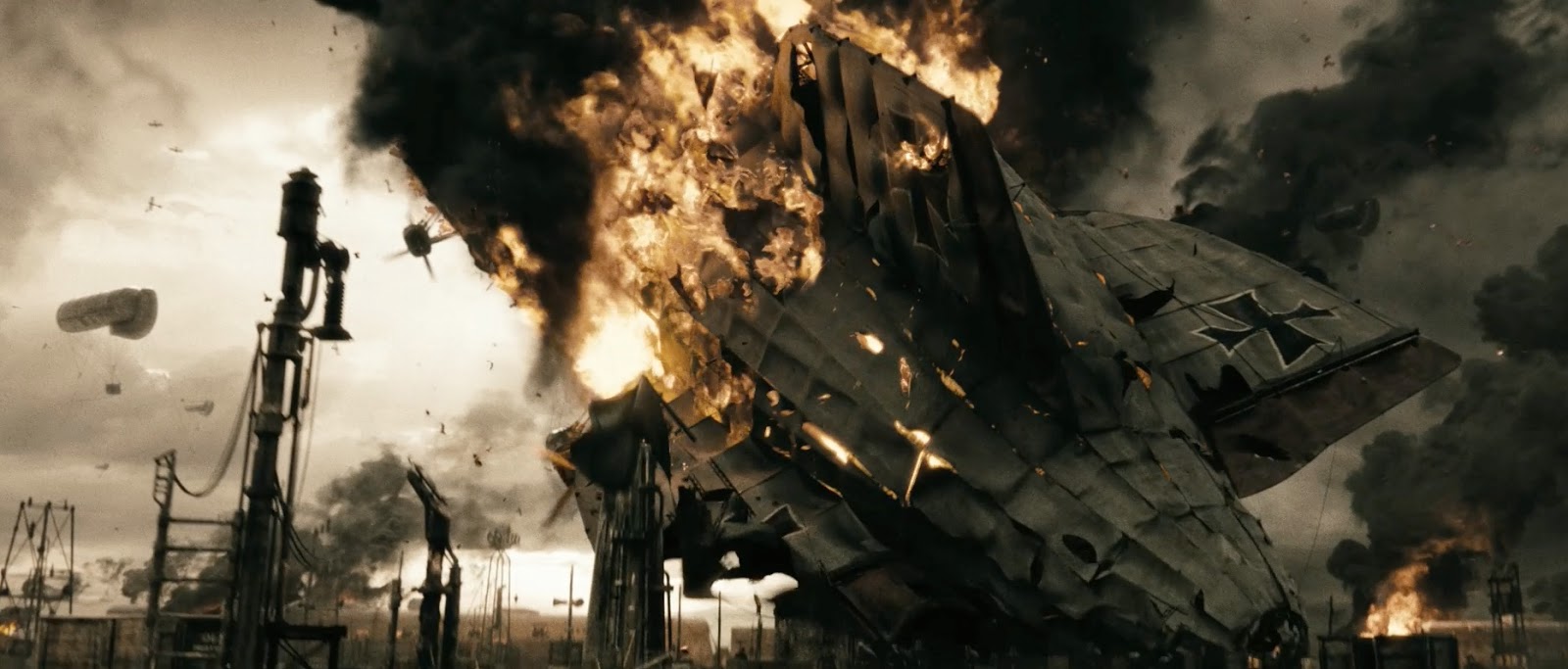
The setting of the second fantasy sequence is modelled on a World War I battlefield, but pumped up to the outlandish scale and intensity of a Star Wars battle. The sky is filled with more biplanes and zeppelins than were probably deployed along the entire Western Front at any one time, and the location has been adjusted so that Chartres cathedral happens to be right in the line of fire – the trenches running right up to the front steps, and its famous flying buttresses collapsing beneath the shockwaves of all the exploding shells. The effect of seeing our five heroines strutting through this setting in slow-motion – dressed in fetishistic leather and sluttish makeup, as opposed to the battered khaki-clad troops on either side of them – is one of the film’s most Decadent moments: the complete divorce from any sense of human commonality on the characters’ part, and any sense of historical restraint on Snyder’s.

The ensuing action sequence is everything one would expect from Hollywood at its best – intense choreography, hyperkinetic editing, and brilliantly maintained suspense. This last is particularly interesting, given that one knows for a fact that none of the heroines are going to get it, just as one knows equally well that none of the German troops have a chance. Hence, one supposes, all of the moments when one of the girls seems momentarily overmatched, pinned down, surrounded, or otherwise threatened, are just formal exercises – there do demonstrate how impressively they can be done, rather than for the sake of any narrative uncertainty about their upshot. We’re told, moreover, that the German soldiers the girls are facing are in fact a kind of steampunk stormtrooper – corpseswhich have been made to walk again through steam power and precision gear-works. And it’s here that the film’s most intriguing aspect rears its head. Many Hollywood spectacles have a deeply problematic politics of empathy, to put it mildly. We’re totally inured to seeing hundreds of  people die horrifyingly, provided they’re anonymous enough, but routinely invited to be terrified and anguished if one hair on the hero’s best friend’s head is touched. And don’t even get one started on the trope of the cute child or dog… Sucker Punch, with the samurai automata and now these steam-troopers, is doing something different. The risk of any loss of life is now precisely zero on both sides, so empathy or concern of any sort doesn’t even enter into the equation. This, in fact, to be the film’s keynote henceforth.

The third sequence takes up the politics of empathy again, but now goes to a very different place with them. This sequence hinges on our three main heroines being dropped from a World War II bomber into the courtyard of a besieged castle, and having to descend into the bowels of the place to slit a baby dragon’s throat, in order to extract the two fire-crystals inside. All goes well, until they are surprised by the baby’s mother, who is understandably enraged. Chasing them, she emerges from the castle blasting fire, causing total mayhem among the besieging forces, before taking flight to chase the girls’ drop plane – piloted by the two subsidiary heroines “Amber” and “Blondie.”

Seeing Blondie fire one of the plane’s machine guns at the dragon, crying “Take that you ugly mother!” seems like exactly the sort of hateful moment one would expect from one of the worse kind of Hollywood designated-heroes. The previous business with the baby dragon was an appallingly callous moment on the heroines’ part, and one’s sympathy is now frankly with the dragon – a reading one doesn’t quite expect to see borne out by the movie. Except that, a moment later, Blondie exclaims that she’s lost the dragon behind one of the castle’s towers – only for it to suddenly emerge and chomp down on the plane’s gun-turret tail, sending it spiralling away downward. The sequence still obligatorily ends with Babydoll skewering the dragon in the head with her katana, but with that one chomp, one suddenly has the sense that Sucker Punch may yet be going somewhere that will surprise you.

This is then borne out in the fourth fantasy sequence. This one takes us into the realm of science fiction. We find ourselves on a terraformed Titan, beneath a yellowy-beige sky, above which Saturn and its glorious rings almost entirely fill the horizon. We’re above a futuristic bullet train, which has been rigged by terrorists with a bomb, set to explode when the train reaches the futuristic megalopolis on the horizon. The girls must fight their way through the innumerable robot guards stationed throughout the train in order to deactivate and extract the bomb. After the opening rounds of the melee play out Matrix-style – with the girls’ bullets and blades shredding the robots in slow-motion – however, the film cuts back to its second level of reality, in the brothel, where the escape plan goes wrong and Rocket gets stabbed. Cutting back into the fantasy sequence, the tide abruptly turns, and Babydoll is sent sprawling into some cargo crates in equally tortuous detail. Sweetpea’s shotgun is smashed out of her hands similarly emphatically, and Rocket takes an incapacitating punch to the face in a positively fetishistic slo-mo close-up. In short order, one of the fallen robots resurges long enough to reactivate the bomb, and their mission ends in failure, with Rocket trapped on the train to be blown to atoms along with the city (Snyder paying homage to his own work in Watchmen). The drama of invincibility has mutated into that of martyrdom in only a few moments.

After this, the film returns to the brothel-reality, with Blue shooting Amber and Blondie in the head, and Babydoll and Sweetpea having to make a desperate break for it on their own. And it’s the one huge, defining disappointment of Sucker Punch that this climax plays out wholly in the brothel-reality rather than in a fifth fantasy sequence that brings the remaining girls to total apocalypse. The film’s ultimate conclusion is so unexpected that it deserves a mega-spectacle analogue like what we’ve seen so far: it turns out to be Sweetpea that gets out and Babydoll that stays behind to sacrifice herself. This plays out via a rapid montage through three different layers of reality, in the course of which she has inflicted upon herself two of the same fates – being shot in the head point-blank, and having her brain skewered – which she’s dealt out so cavalierly throughout the preceding sequences. There’s a satisfaction to this that, as I said, one is very rarely afforded in Hollywood movies. In most, when you are presented with a meek, blushing, young heroine who insists that we must all work together to escape from the clutches of our nefarious captors; another young girl who believes in her right away; and an older girl who attempts to kibosh her idealism with phrases such as “too risky” and “what makes you so special?” then it’s a no-brainer to guess which two are going to survive until the end. The fact that Snyder has flouted that logic, even more than all the amazing digital fantasy spectacles on offer, is what makes Sucker Punch so amazingly revolutionary a film, and demonstrates once again that being mainstream entertainment is no excuse for infantilism.